
Today, the price of economic security is unaffordable for most American families. The cost of housing is a major reason why: Housing is the single largest expense on the household budget for most families in the US. Accordingly, recent polling indicates that housing affordability is the biggest financial concern for most voters under 65 and young voters across the political spectrum.
Congress is actively debating a bipartisan legislative package that could be a critical first step in tackling the housing affordability crisis. The federal government plays a massive role in the US housing market – it currently spends hundreds of billions of dollars each year on initiatives that support tens of millions of households and housing units annually. And the US has weathered worse housing crises through concerted federal interventions and large-scale investments, meaning it has significant power to alleviate the current crisis.
But reducing housing costs for renters, homebuyers, and people experiencing homelessness is a complex challenge that can’t be solved by one bill in Washington. Progress will require continued federal action and dedicated partnership from state and local leaders. The federal government’s role is to provide the leadership and resources needed to advance a sustained, comprehensive national housing affordability strategy. Here, we establish principles of such a strategy.
1. Align supply investments with demand-side support.
Deep shortages of affordable housing have been the primary driver of high housing costs, but tackling the lack of supply cannot be a standalone strategy. It takes years to build housing, and research has consistently shown that building housing alone is insufficient to meet the lowest-resourced households.
Thus, an effective national housing affordability strategy that supports families of all income levels and renters, homebuyers, and the unhoused must include interventions that address lack of supply—such as reducing the cost of construction, financing, and regulation—as well as demand, by increasing households’ ability to afford housing and lowering its user costs.
2. Deploy the full federal toolkit.
Congress can ensure a federal legislative package is comprehensive by utilizing the range of tools at its disposal, by
- Unlocking production capacity: Creating the conditions to build and rehabilitate more housing units of all kinds and lowering the cost of housing’s inputs—land, labor, building materials, and regulation—will help drive down costs in the long term. Federal proposals have sought to accomplish this by providing incentives to prohousing jurisdictions and exempting homebuilding materials from tariffs.
- Injecting capital: Federally supported credit markets have long been integral to the supply and demand for housing, that is, housing production and homebuying. Continuing to provide liquidity will enable critical low-cost financing to build and rehab more housing and help make homeownership possible. Federal proposals have sought to accomplish this by providing a tax credit to make building and rehabbing single-family homes financially feasible in all communities and introducing a new zero–down payment mortgage product through the Federal Housing Administration.
- Protecting and assisting consumers: Building enough housing will take years, and people need to be able to afford housing today. Federal proposals have sought to help renters, homebuyers, and people experiencing homelessness overcome financial barriers by expanding and streamlining the Section 8 housing voucher program and establishing a federal down payment assistance program for first-generation homebuyers.
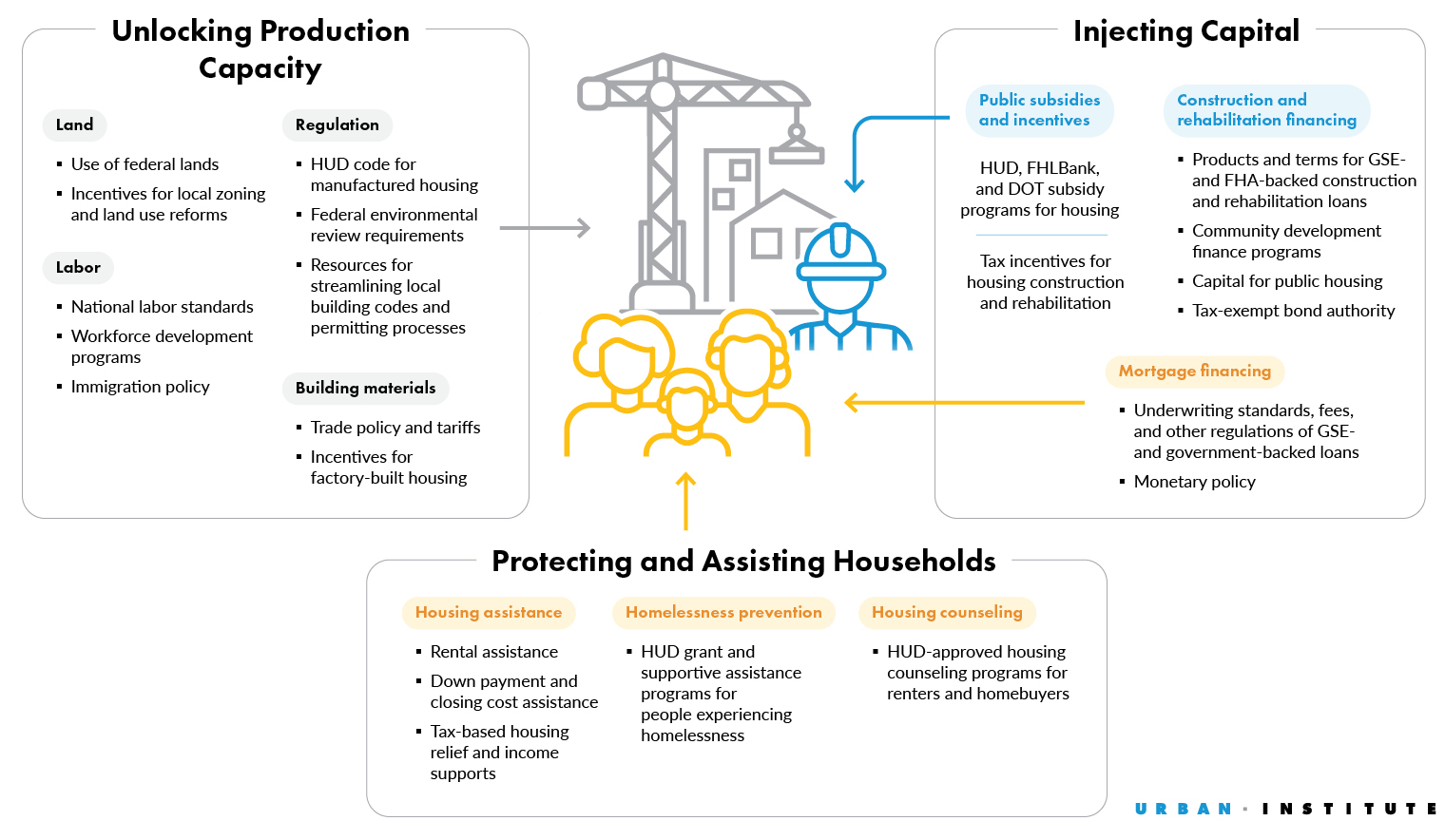
Source: Framework developed by the authors.
Note: Examples are a noncomprehensive list of policy and programmatic tools under the purview of the federal government. HUD = US Department of Housing and Urban Development. FHA = Federal Housing Administration, GSE = government-sponsored enterprise, FHLBank = Federal Home Loan Bank, DOT = US Department of Transportation.
All three elements are needed to address today’s housing challenges. For example, unlocking production alone will allow for higher-density development and lower development costs, but it won’t necessarily stimulate affordable housing production in all areas. Providing financial assistance to consumers will help them afford housing but should be paired with measures to increase supply as to not drive up rents and home prices. And injecting capital on its own will have limited effects without measures to unlock the market for different housing types.
3. Prioritize based on impact, efficiency, and feasibility.
In an ideal world, interventions of all these kinds are needed to improve affordability for all households in all places. But in reality, policymakers face fiscal and political constraints. When designing a comprehensive housing package, Congress can do the following:
- Balance cost and impact: Congress should consider their returns on investments when prioritizing policy and program options. For example, new financing, grants, and direct spending programs will likely cost more upfront but will likely stimulate more units than zoning and land-use reforms alone. A multipronged approach that pairs such large investments with the myriad no- or low-cost options—such as making federal grant programs easier to use, leveraging existing funding streams by allocating approved funding for specific purposes, and mobilizing private investment as the Low-Income Housing Tax Credit program does—will be the most effective in the short and long term.
- Target assistance effectively: Evidence shows that direct assistance dollars targeted to those with the greatest needs, such as people experiencing homelessness; low-income renters, for whom affordable units are seldom available; and first-generation homebuyers, who experience the greatest challenges overcoming the upfront cost of homeownership—effectively make affordable housing more accessible and could help mitigate any potential inflationary effects on home prices and rents (PDF).
- Ensure implementation capacity: Effective policies and programs are both well designed and undergirded by a well-supported infrastructure to deliver them. For example, if lawmakers task the US Department of Housing and Urban Development (HUD) with initiating new programs and carrying out new functions, they should concurrently ensure the agency has the technological and staffing capacity necessary to carry out such initiatives, especially in light of recent deep staffing cuts. In addition, continued funding for HUD programs is necessary to help state and local governments execute their critical operations in the housing ecosystem.
Americans urgently need affordable housing. Addressing a crisis of this magnitude will require continued federal leadership and investment beyond legislation currently being negotiated in Congress, guided by a comprehensive national strategy that drives down costs for all families.
