
Amid national economic uncertainty, communities across the US are looking for ways to spur local growth. Often, equity and growth are treated as competing goals. But our new research on Fairfield County, Connecticut, shows this isn’t true. Equity isn’t just a moral goal; it’s an economic growth strategy.
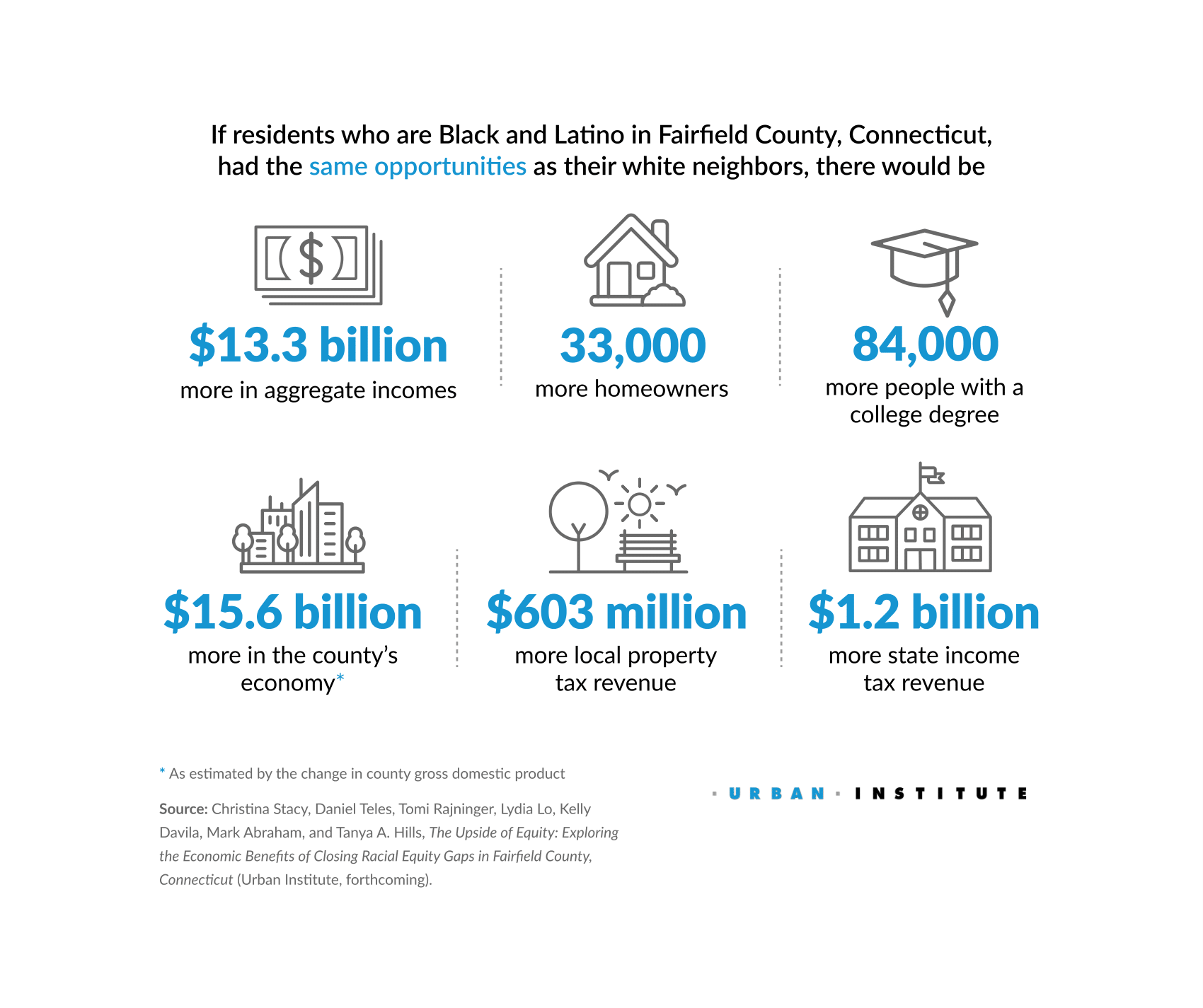
Our recent report shows that closing racial and ethnic income gaps in the county could add $15.6 billion to the local economy. This is not a local success story waiting to happen—it’s a powerful example for communities nationwide that addressing racial inequities can boost local economies.
Addressing racial inequities improves individual outcomes that fuel local economies
Increasing racial equity in places like Fairfield County would not only increase the local gross domestic product but also benefit community members through increased incomes, homeownership, and attainment of college degrees. These outcomes would in turn increase property and income tax revenues, which could be reinvested into other benefits for the economy as a whole.
To conduct this research, we used American Community Survey microdata to assign Black and Latino survey respondents the incomes, education levels, and housing market outcomes of their most similar white counterparts. We then simulated outcomes for income, educational attainment, and the housing market using the matched microdata.
We find that if income disparities were erased, the average annual income for Black adults in Fairfield County would rise by $57,594, and for Latino adults by $58,815. These increases would boost household financial stability, reduce poverty, and expand economic mobility, creating ripple effects across the regional economy.
These income gains wouldn’t help just households. They’d also fuel increased state revenues. Using current tax formulas, Fairfield County would see $47 million more in state aid. If all additional revenue were directed to public schools, that number would grow to $184 million. This would be enough to hire between 277 and 1,382 new teachers or raise teacher salaries by $3,701 to $14,398 per teacher per year.
Increases in racial equity could also equate to an additional 33,000 residents owning their homes and an increase in aggregate home values of 17 percent. This would translate into $603 million additional dollars of property tax revenue, which could be used to fund local amenities like libraries, parks, emergency services, police, transit, and improved road safety.
How communities across the country can advance racial equity
This research shows us that equitable growth isn’t just about helping those left behind—it’s about creating stronger, more-resilient communities for everyone. As communities respond to rising housing costs, climate shocks, and shifting labor markets, equitable economic development must be front and center.
We all have a role to play in increasing equity in our communities. Below are some recommendations for how various stakeholders can work to increase equity and thereby improve their local economy:
- Business leaders can offer registered apprenticeships and tighten job descriptions to remove any nonessential job requirements, such as college degrees, which could prevent Black or Latino people from qualifying because of discrimination in the education system or other social systems.
- Philanthropic organizations can fund targeted universal preschool and pool resources to make grant funding available to small businesses.
- Local governments can offer downpayment assistance for first-generation homebuyers and forecast upcoming procurements to give small firms more time to prepare.
- State governments can adjust funding to prioritize high-need schools and support baby bonds, which provide children with government-funded savings accounts to support their future economic prosperity.
- The general public can advocate for housing development locally, particularly affordable housing, and patronize businesses that support the practices noted above.
Fairfield County’s experience highlights a broader reality. Communities across the United States are losing out on billions of dollars in economic potential by allowing disparities in income, housing, education, and employment to persist. But by investing in equitable solutions—such as inclusive workforce development, quality education, and affordable housing—cities and counties can unlock that potential for everyone. Fairfield County’s lesson is clear: The path to a stronger economy runs through equity.
