
Why This Matters
With homeownership becoming increasingly out of reach for today’s first-time homebuyers, the federal government can use its many tools to implement a national housing strategy to support access to homeownership on the supply side (the home) and the demand side (the homebuyer).
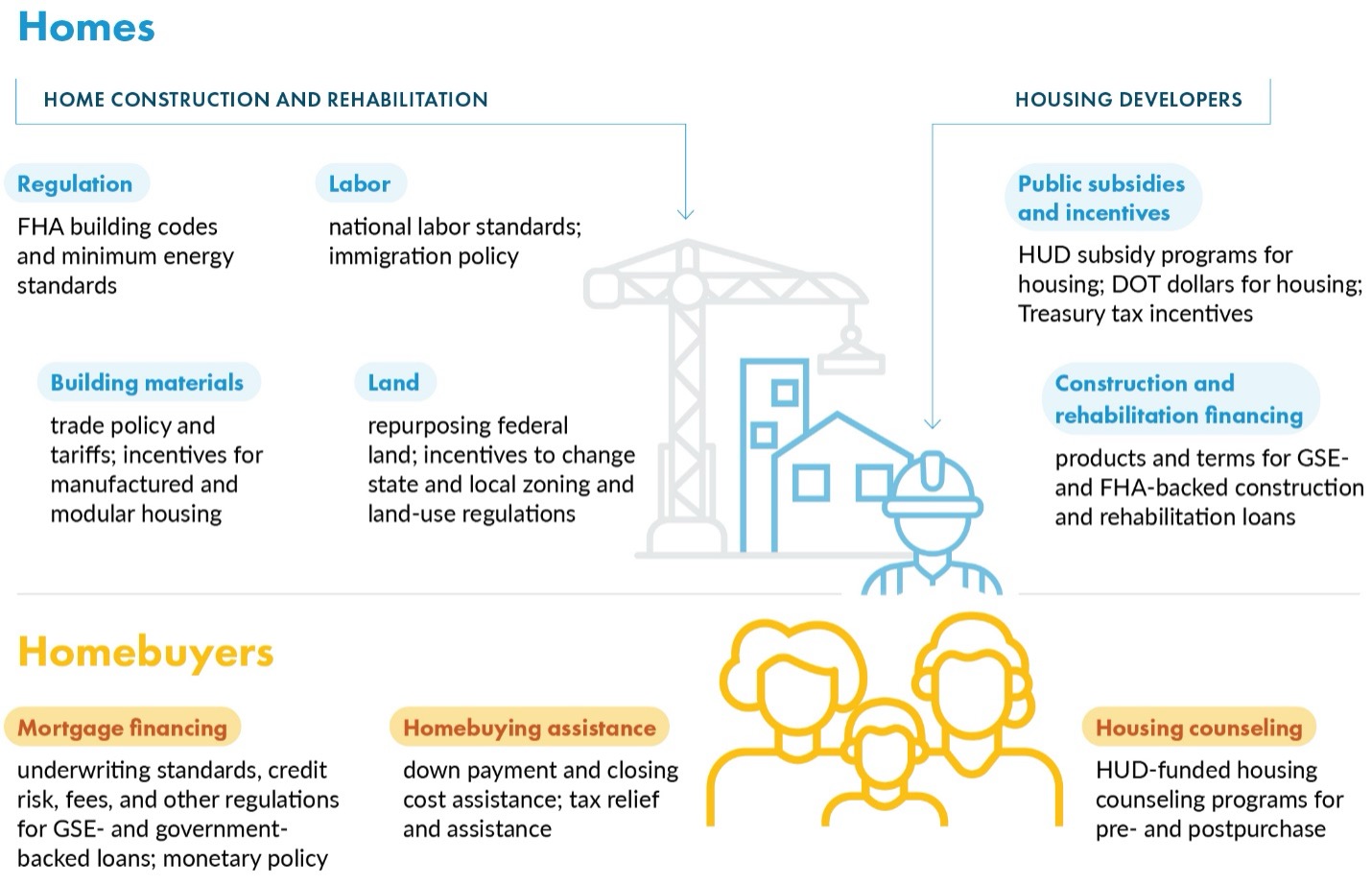
Source: Framework developed by the authors.
Notes: FHA = Federal Housing Administration; GSE = government-sponsored enterprise ; HUD = US Department of Housing and Urban Development; DOT = US Department of Transportation; Treasury = US Department of the Treasury.
Key Takeaways
To effectively boost homeownership, a national housing strategy should prioritize the following
Increasing the Supply of Starter Homes
- Create incentives for private investment.
- Expand financing for affordable home construction and preservation.
- Support states and localities in lowering regulatory barriers.
- Explore solutions to repurpose federal lands, eliminate trade barriers on building materials, and preserve the labor
- Preserve public subsidy programs that work.
Lowering Financial Barriers for First-Time Homebuyers
- Reform underwriting standards to increase access to mortgage financing.
- Lower upfront costs of homeownership with homebuying assistance.
- Continue support for housing counseling.
How We Did It
To produce this analysis, we pulled from prior Urban research on policies to expand access to homeownership.
